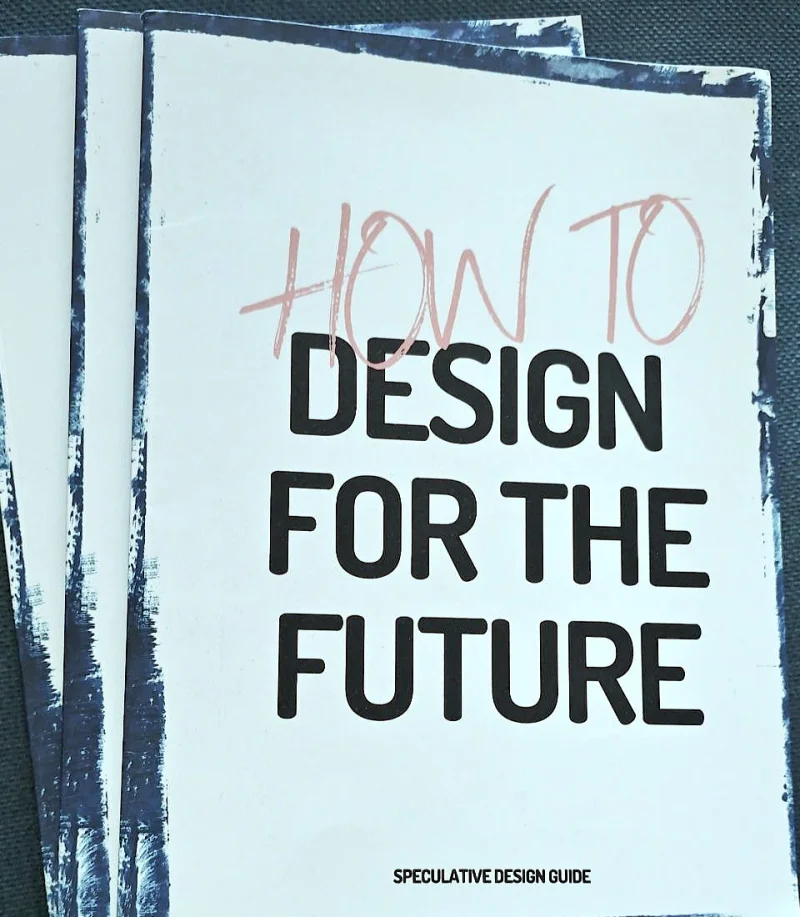
CALIFORNIA & MANNHEIM — March 17, 2025 — The Climate Change and Speculative Design (CCSD) network is proud to announce the publication of How to Design for the Future, an educational guide and design handbook developed in collaboration between California State University, East Bay and Technische Hochschule Mannheim.
This book serves as a vital pedagogical manual and project anthology, designed to equip students, researchers, and practitioners with structured tools to construct alternative future scenarios that challenge linear thinking and growth-driven economic models.
“Speculative Design is not just a method; it is an attitude,” note authors Ian Pollock and Kai Beiderwellen. “By combining observation, analysis, and imagination, it allows us to construct alternative future scenarios – utopias that should not be dismissed as mere fantasies but embraced as concrete answers to the question: How could things be different?”
The guide outlines the frameworks taught during the transatlantic graduate program, including the Polak Game, STEEP scanning, Foresight Archetypes, and User Journey mapping, culminating in the development of tangible speculative artifacts ('provotypes') and world-building narratives set in the year 2070.
Book Chapters & Table of Contents
- Setting the Stage for Speculative Design & Strategic Foresight p. 4
- 01. Imagination and Reality in Future Thinking p. 6
- 02. Scoping Design Objective p. 8
- 03. The Polak Game – Assessing Perspectives on the Future p. 10
- 04. Signals and Trends: Understanding the Indicators of Change p. 12
- 05. STEEP – Signals and Trends for Foresight p. 14
- 06. Exploring Foresight Archetypes: A Framework for Understanding p. 18
- 07. Visions for Desirable Futures – The Role of Narrative p. 24
- 08. Imaging Life: How Do People Live in This Future? p. 26
- 09. User Journey Mapping: Identifying Opportunities for Design p. 30
- 10. A Thing for the Future: Speculative Design for Future Living p. 34
- 11. Transatlantic Group Projects Showcase p. 38
- The Future of Coral Reefs (p. 39)
- The Future of Transportation – GO!RICKSHAW (p. 44)
- Waste2Taste (p. 47)
- Harvesting Hope (p. 51)
- FlexFitCube (p. 56)
- Credits & Contributors p. 60
Foreword to the Publication
The future stands on shaky ground. The climate crisis and other global challenges compel us to rethink old paradigms, adopt new perspectives, and boldly imagine beyond what currently exists. This publication from the Climate Change and Speculative Design (CCSD) project represents a first step in that direction – an attempt to explore the possibilities and methodologies of Speculative Design and to harness them in the service of a sustainable and equitable future.
Speculative Design is not just a method; it is an attitude. It challenges us to leave familiar paths behind and venture into the unknown with creative audacity. By combining observation, analysis, and imagination, it allows us to construct alternative future scenarios – utopias that should not be dismissed as mere fantasies but embraced as concrete answers to the question: How could things be different?
As writer Ilija Trojanow aptly points out, we need utopias today more than ever: “Can it really be that the current state of things is the only possible reality?” Utopian thinking is too often dismissed as naive, irrational, or even dangerous. Yet history repeatedly shows us that it is a fertile ground for alternatives – a driver of change. Without the ability to think the unthinkable, much of what we take for granted today would never have come to be.
The world as it exists today is neither without alternatives nor immutable. It is painfully evident that profit-driven motives, growth ideologies, and the concentration of power are pushing us beyond the planet’s limits. And yet, as Trojanow observes, “our thinking has grown small and narrow.” In the face of pressing ecological and social crises, it is not knowledge or commitment that we lack, but often the capacity and courage to seriously pursue alternative paths.
This is where CCSD steps in. At the heart of our work lies the conviction that imagining and exploring alternative futures is not merely an intellectual exercise but an essential societal task. Speculative Design serves as a tool to make the utopian concrete and tangible – connecting ethics and vision not only to critique existing systems but also to chart paths toward a more just and ecologically sustainable world.
A key feature of CCSD is its intercultural and collaborative approach. Through the partnership between California State University East Bay and Mannheim University of Applied Sciences, scenarios are developed that integrate diverse cultural perspectives and foster global approaches. Projects like our pilot initiative, MIGRATION 2070, and methodologies such as Mapping Archetype Scenarios across the Three Horizons not only explore the world of tomorrow but also challenge people today to engage critically with the possibilities and limitations of the present.
We do not see Speculative Design as a closed system but as an invitation to dream, design, and experiment together. As Trojanow writes: “The utopian is a seed in every human being.” It lives in our imagination but also in the concrete alternatives already emerging today – in solidaristic communities, regenerative economic models, and innovative technologies.
The task of Speculative Design is to identify these seeds, nurture them, and help them flourish. Because, as Carl Zuckmayer once said, “The world will never be perfect, but it could be better.” Without the dreams that fuel our imagination and the designs that make them tangible, we risk falling into hopelessness.
With this first publication, we hope to make a contribution – to the discourse, to inspiration, and, above all, to the concrete shaping of a future that transcends the possible and places the desirable at the center.
Ian Pollock & Kai Beiderwellen
CCSD
January 2025