Fall 2025 updates coming soon

Imagining Migration Futures in 2070
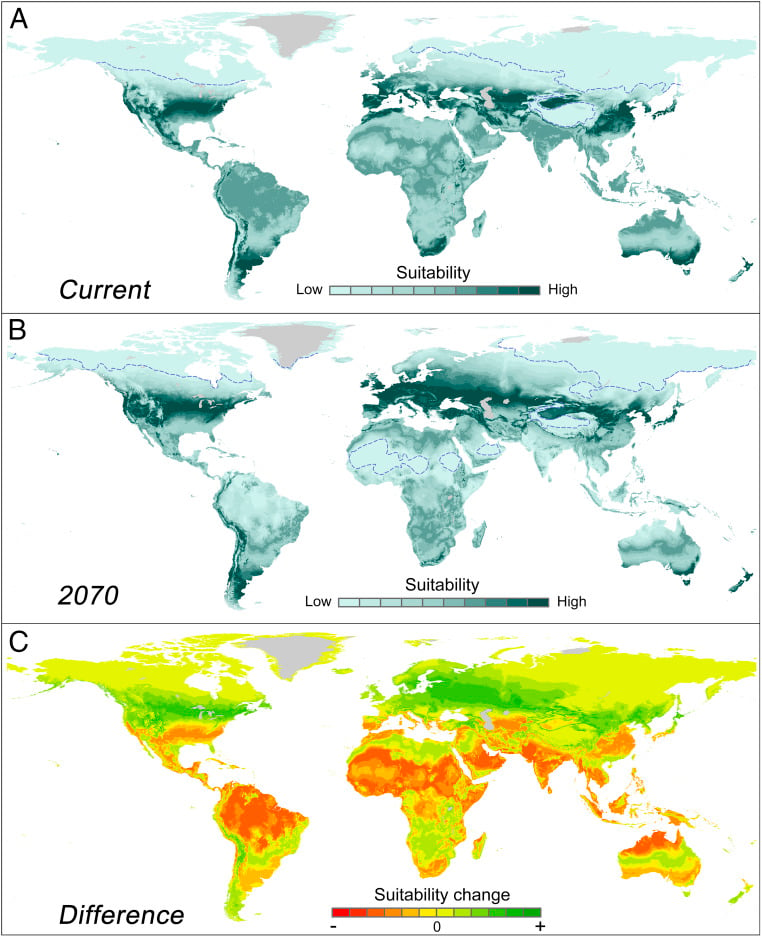
For nearly 6,000 years, human civilization has flourished within a surprisingly narrow temperature band. We are, biologically and socially, creatures of a specific "climate niche"—a sweet spot where mean annual temperatures hover between 11°C and 15°C. This specific climate envelope enabled the birth of agriculture, the rise of cities, and the explosion of global trade. But by 2070, that map will look radically different.
5/8/20242 min read
For nearly 6,000 years, human civilization has flourished within a surprisingly narrow temperature band. We are, biologically and socially, creatures of a specific "climate niche"—a sweet spot where mean annual temperatures hover between 11°C and 15°C. This specific climate envelope enabled the birth of agriculture, the rise of cities, and the explosion of global trade. But by 2070, that map will look radically different.
The Collapse of the Climate Niche
Recent modeling, including a landmark study published in PNAS, suggests that if current emissions trajectories continue, the human climate niche will shift more in the next 50 years than it has in the last six millennia.
By 2070, roughly 19% of the Earth's land surface—home to a projected 3 billion people—could experience mean annual temperatures greater than 29°C (84°F). To put that in perspective, such conditions are currently found in only 0.8% of the world’s land area, mostly in the deepest parts of the Sahara Desert.
This is "climate niche collapse." It is not merely a matter of hotter summers; it is the expansion of "unlivable" zones into densely populated regions across South Asia, Sub-Saharan Africa, and South America. When the biological baseline for survival disappears, movement becomes the only viable adaptation.
The Numbers: UN and World Bank Projections
We are already seeing the signals. The UN and the International Organization for Migration (IOM) have long warned of mass displacement, but the scales are shifting from "crisis" to "megatrend."
Internal Displacement: The World Bank’s Groundswell report projects that by 2050, up to 216 million people could move within their own countries due to slow-onset climate factors like water scarcity, crop failure, and sea-level rise.
The Billion-Person Question: Broader estimates from the Institute for Economics and Peace suggest that by 2050, over 1 billion people could be living in countries with insufficient resilience to withstand ecological threats.
By 2070, these figures will likely compound. As the "Sahara-like" heat zones expand, the distinction between "economic migrant" and "climate refugee" will dissolve. Migration will no longer be an emergency response to a singular disaster, but a permanent, structural feature of global demographics.
Three global maps visualizing the shift in the human climate niche by 2070. The data compares current habitable zones with projections for 2070, showing the ideal temperature for human life moving away from the equator. A "Difference" map highlights the Global South (including Central Africa, South America, and India) in orange to indicate a massive loss of habitability, while northern latitudes (including Canada, Europe, and Russia) are highlighted in green to show increased suitability.
Xu, C., Kohler, T.A., Lenton, T.M., Svenning, J., & Scheffer, M. (2020, May 4). Future of the human climate niche. Proceedings of the National Academy of Sciences of the United States of America (PNAS). Retrieved from https://www.pnas.org/content/early/2020/04/28/1910114117
Rice, D. (2020, May 4). Unsuitable for ‘human life to flourish’: Up to 3B will live in extreme heat by 2070, study warns. USA Today. Retrieved from https://www.usatoday.com/story/news/world/2020/05/04/world-heat-conditions-unlivable-global-warming-unabated/3063849001/
Participating Universities
Technische Hochschule Mannheim
California State University, East B ay
© 2026. All rights reserved.